
Some of my earliest fabric designs were created for place mats. They belong on a table, so I decorated them with food themes for different times of the day.


Acrylic paint, acrylic varnish, cotton cloth. 1994.
40×30 cm
Some of my earliest fabric designs were created for place mats. They belong on a table, so I decorated them with food themes for different times of the day.
Acrylic paint, acrylic varnish, cotton cloth. 1994.
40×30 cm

Katazome is a technique of decorating fabric where areas of fabric which are not to be dyed or painted are blocked out. There are many different ways of blocking out; a well-known one is batik, where wax keeps dye or fabric paint from bonding with the fabric. Katazome is a Japanese technique, using rice flour paste as a resist or mask. I tried this on coarse cotton, and it did work, even though finer fabric would have given more detailed results. If following the traditional method, I would have used a stencil, but I preferred to do my geometric design freehand.


In my early teens an old neighbour once gave me a pile of wooden cigar boxes. I used them to create what’s called “Guckkasten” in German, a perspective box or peep-show box. They contain small bric-a-brac figures in front of a matching background, arranged like frozen scenes of a play. I still have some of the original cigar boxes, and recently I needed one to make a small stage for the tin figure of Charlie Rivel, the famous Catalan circus clown. His stage-in-a-box got a luxurious curtain, gold glitter, a proper shadow and a matching frame. Curtains up!


Pewter figures, wood, glass, paper, acrylic paint.

This box is called The Pink Dress.
16×16 cm

A collagraph combines elements of intaglio and relief printing on one printing plate by adding layers of adhesive or solid material to it. I have used the smooth side of a sheet of hardboard and created an image with glue, acrylic texture medium, carborundum and engraving tools.

Tree Shelter
Speedball waterbased relief ink,
Charbonnel intaglio ink on cartridge paper. 2007
43×48 cm
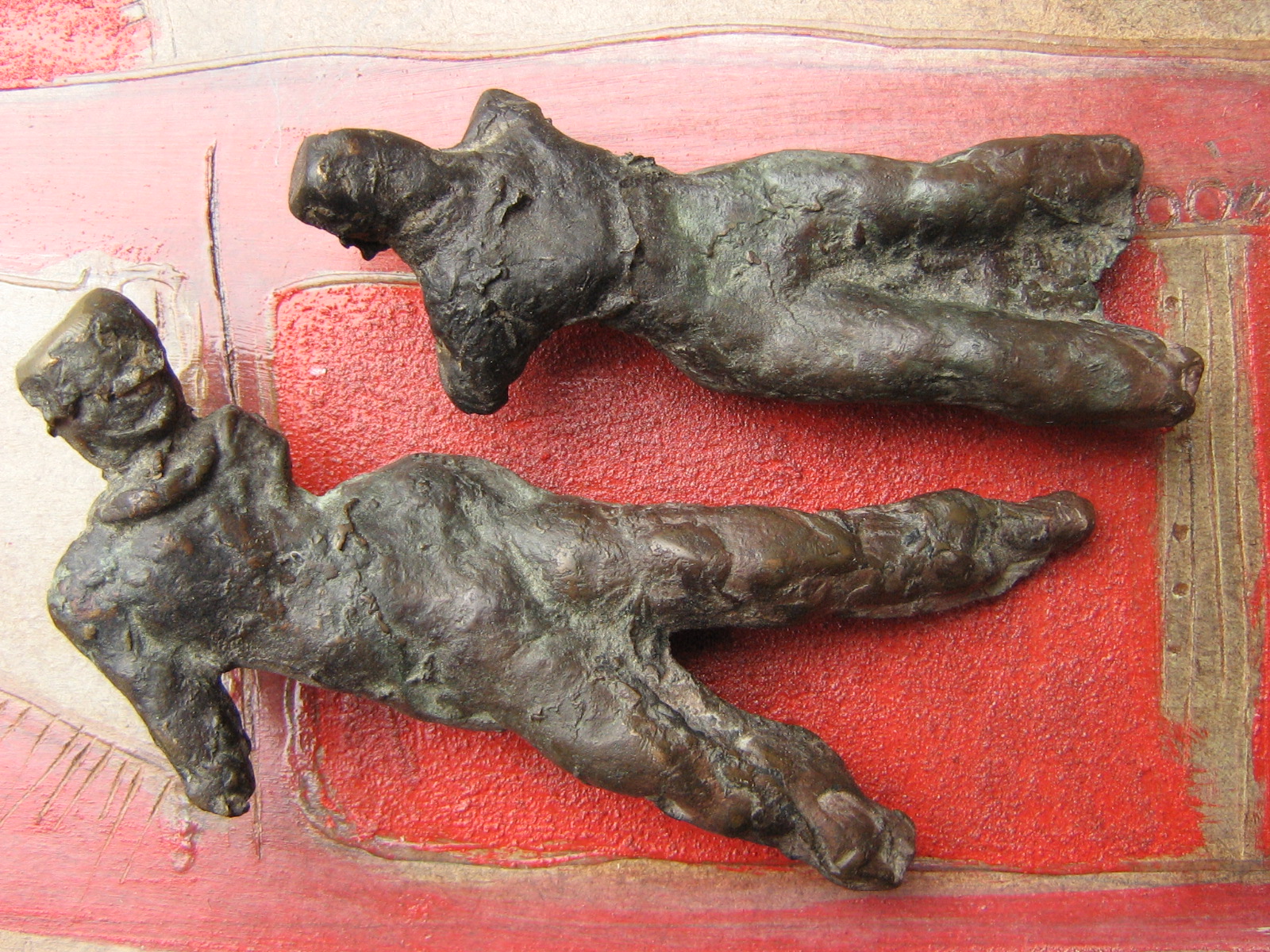
These figures are the result of a bronze casting workshop in Kinsale, Cork, Ireland. I was introduced to hand-built equipment – a kiln and a furnace, plus a roofer’s torch and butane gas as fuel. The students used the lost wax technique: we made models from casting wax, enveloped them in a mixture of horse dung (matured!) and clay, and fired the clay to melt the wax core. This clay mould was then filled with molten bronze – a task we weren’t allowed to do ourselves, much to my relief – handling a crucible with red-hot molten metal is quite scary. Grinding away casting seams and the application of patination media added the finishing touch.
The rather squarish shape of the figures’ heads reveal where the casting funnel was attached to the clay mould, and the “skirt” of the female figure appeared accidentally because I didn’t press the clay-dung mixture hard enough around the wax model. Learning curve…

Bronze, patina. 2007.
Height: 13 cm and 15 cm